
News
Contact UsLuggage Strap Sizes: Buckles, Locks, Fit, and Sourcing
-
 author
- 08 October 2026

Choose luggage strap sizes by measuring the complete wrap path around the target suitcase, then confirming that the closed strap can adjust both below and above that measurement. Nominal length alone is not enough because the buckle, lock body, required overlap, and loose tail affect the usable range. After fit is resolved, select a plain buckle, password lock, or TSA-lock configuration for the intended customer and market.
Retailers and private-label buyers should approve the working range, closure operation, webbing, artwork, and packaging on representative suitcases before production.
Measure the Intended Strap Path
Decide how the customer will use the strap before taking a measurement. A horizontal wrap runs around the suitcase body from side to side. A vertical wrap runs around the height and usually passes near a top or side handle. A crossed arrangement uses two straps and creates two separate paths. The required length changes with each method, even on the same suitcase.
- Pack the suitcase to a realistic shape and close all expansion panels that belong in the standard use case.
- Run a flexible tape around the intended path without pulling it into soft panels or padding.
- Record the circumference and note any handle, wheel housing, or corner that changes the route.
- Repeat the measurement on the smallest and largest suitcases the SKU is expected to fit.
- Add the supplier’s required buckle overlap or locking allowance, then confirm the working range on a sample.
For a retail program, keep the smallest and largest measured paths in the specification. A statement such as fits most suitcases is difficult to inspect. A working closed-loop range gives the supplier and buyer an objective check, while photos of the intended horizontal or vertical route prevent a correct measurement from being applied to the wrong path.
Interpret Nominal Length Width and Adjustment
A flat strap length is not the same as its maximum usable circumference. Part of the webbing passes through the adjuster, buckle, or lock, and the product needs enough overlap to remain set. At the short end, excess webbing may create a long tail or a bulky doubled section. Ask for the minimum and maximum closed-loop measurements rather than relying only on the cut length.
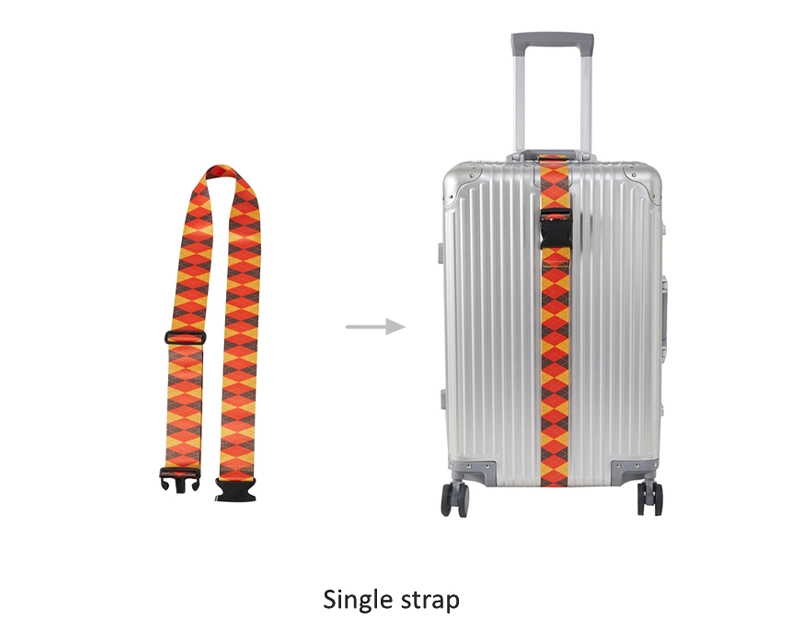
JUSTOP lists its normal adjustable buckle luggage strap at 5 x 200 cm, and the password model is also listed at 5 x 200 cm. Those figures are useful starting references for two specific products. Buyers should still request the minimum and maximum closed-loop fit, because buckle geometry and adjustment overlap determine how much of the nominal length is usable.
Width affects visibility, hardware choice, print space, and how the strap sits against the case. Do not infer load capacity from width or material name alone. If a strength claim is important to the sales message, define the finished product, test method, sample size, acceptance threshold, and documentation before the wording is approved.
Choose the Buckle or Lock Type
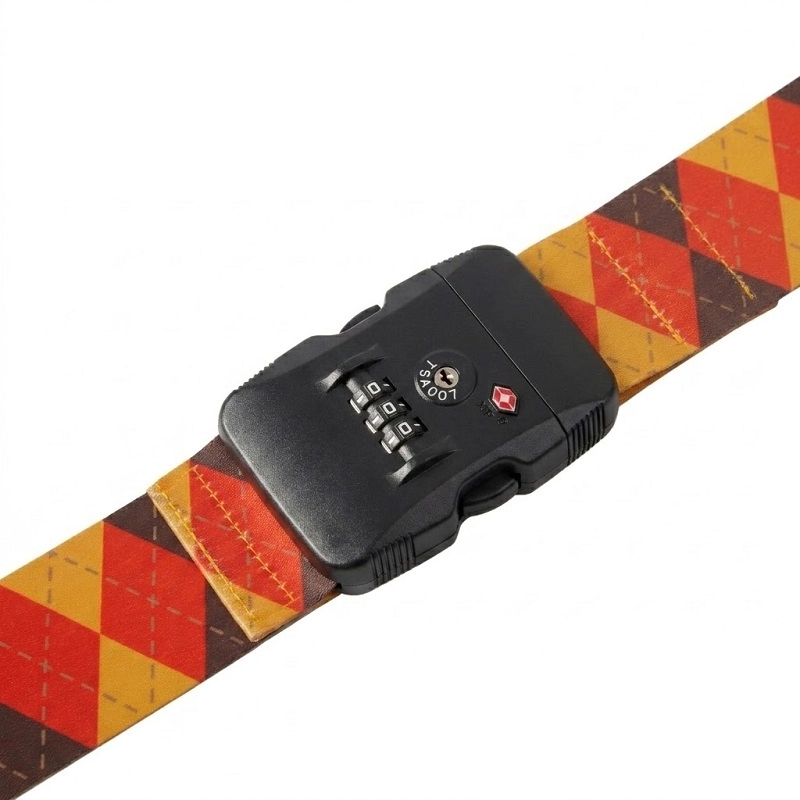
The JUSTOP luggage strap range presents three relevant configurations: an adjustable buckle, an integrated password lock, and a TSA-lock model with an information-card holder. This lets a buyer build a range around distinct user jobs rather than cosmetic variations. The closure should match the price position, instructions, and specific documentation the sales channel can support.
| Configuration | Suitable range role | Buyer checks | Main limitation |
|---|---|---|---|
| Plain adjustable buckle | Simple entry product and easy repeat use | Buckle operation, adjustment hold, webbing path, and tail management | No integrated locking function |
| Password lock | Range tier for customers who want an integrated code lock | Code setting, reset instructions, lock alignment, and access after repeated cycles | Adds instructions and a possible support issue if users forget the code |
| TSA-lock and ID card | Travel-focused tier combining a lock and identification feature | Lock documentation, permitted wording, card access, instructions, and target-market review | TSA-related wording must not imply approval of the entire strap or brand |
A password-lock luggage strap and a TSA-lock luggage strap with an ID card holder solve different merchandising tasks. For any TSA-related claim, request current documentation for the lock component and confirm the permitted wording in the target market. Do not extend that claim to webbing strength, loss prevention, or the finished product as a whole.
Specify Wrap Orientation and Handle Routing
The strap should remain in its intended path during normal handling. Routing through a fixed suitcase handle can reduce movement, but not every case has a handle in the required position.
Test the product on hard-shell and soft-sided examples that represent the program. Check whether the buckle or lock rests on a flat surface, catches near an edge, or presses against a handle when the case is lifted.
If two straps are sold for a crossed arrangement, specify whether the customer receives identical straps or a coordinated pair. The packaging should show the intended route and state what is included. Avoid implying that a strap prevents every zipper failure or guarantees recovery of misplaced baggage. It is an accessory whose fit and use must be clear.
Use Color and Print for Identification Without Overclaiming
Color and pattern can help a traveler distinguish a case at baggage claim, which makes them useful assortment variables. Decide whether visibility, brand recognition, a promotional message, or coordination with other travel accessories is the main job. The answer determines print scale, repeat pattern, logo position, and the number of colorways worth sampling.
Review artwork on a closed loop around a suitcase. A design approved on flat webbing may disappear into the adjuster, split across an overlap, or sit under the buckle.
Confirm the repeat, orientation, color reference, and readable logo area on the smallest and largest approved loops. Packaging should describe improved identification as a practical aid, not a guarantee against loss or mistaken handling.
Approve Fit Operation and Repeat Order Quality
JUSTOP’s OEM service accepts existing drawings or samples for production. Its stated quality-control process covers incoming materials, production-stage inspection, and outgoing sampling. Buyers should add strap-specific acceptance points for closed-loop fit, buckle or lock operation, webbing, seams, print placement, instructions, and packing so repeat orders are checked against the approved construction.
- Measure flat dimensions and the minimum and maximum working loops against the approved specification.
- Fit the strap to the smallest and largest target cases in every advertised orientation.
- Cycle the buckle, adjuster, password lock, or TSA-lock component and record any sticking or unintended release.
- Inspect webbing edges, seam alignment, reinforcement, hardware contact points, and excess-tail control.
- Compare print position, repeat, color, and logo legibility on the closed loop rather than flat material.
- Check instructions, set count, labels, unit packing, and carton requirements before shipment approval.
Prepare a Comparable Luggage Strap RFQ
Send the smallest and largest measured strap paths, required working range, width, closure type, wrap orientation, webbing direction, artwork files, color references, packaging, estimated quantity, target market, and timing.
State any performance or TSA-related claim that needs documentation. If suppliers quote different closures, dimensions, or packing, normalize those items before comparing price.
To discuss a custom strap, contact JUSTOP with the target suitcase measurements, preferred buckle or lock, artwork, quantity, and packing method. A short measurement table and a marked reference photo will usually communicate fit more clearly than a general request for a universal suitcase strap.
Conclusion: Specify the Working Range
Reliable luggage strap sizes start with the measured wrap path and end with a verified working loop, not a nominal flat length. Confirm fit on the smallest and largest target suitcases, then choose a plain buckle, password lock, or TSA-lock configuration for a clear range role. Approve handle routing, excess-tail control, artwork, instructions, and packing on the finished sample. Those steps give buyers a specification that can be quoted, inspected, and repeated.
FAQ
What Size Luggage Strap Do I Need?
Measure around the suitcase on the exact horizontal, vertical, or crossed path you plan to use. Then choose a strap whose verified closed-loop adjustment range extends below and above that measurement. Do not rely only on flat cut length or a general suitcase-inch label.
How Do I Measure a Suitcase for a Luggage Strap?
Pack the case to a realistic shape and run a flexible tape around the intended route. Note handle routing, expansion panels, and corners. Measure the smallest and largest target cases, then confirm the result with the actual buckle or lock because overlap changes the usable loop.
Do Adjustable Luggage Straps Fit Every Suitcase?
No adjustable strap should be assumed to fit every suitcase. Cases vary in circumference, expansion, handle position, and shell shape. Verify the product’s minimum and maximum working loops and test the intended route on representative cases before making a fit statement.
Should I Choose a Buckle or Lock Luggage Strap?
Choose a plain buckle for simple closure and repeat use. Choose a password lock when an integrated code lock matches the range position. Consider a TSA-lock model only when its component documentation and target-market wording are verified. Test every closure repeatedly on the finished sample.

Our Products
Our Products


our testimonials
What They Say About Us

“Super patient throughout communication—efficient and professional. This collaboration was so hassle-free!”

“Both quality and service exceeded expectations. The details are on point—I’ll definitely recommend it to friends!”

“Delivered right on time, and the product matched every detail we discussed. Totally satisfied!”